


Things are winding down here for me now as I have only 3 weeks remaining in Pune. Last week my computer died. I have discovered that I will need a new display, which has to be ordered from Bangalore. Fortunately a flatmate has loaned me hers to use for a couple of hours, so I will get this post written.
The Experience of Open Practice at RIMYI
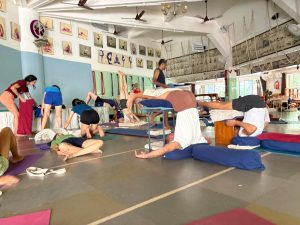 One of the most powerful experiences of being at the Iyengar Institute is the practice time. I recall that it felt a bit intimidating the first time I was here, in 2009. I’d walk in and see so many people doing different things and wouldn’t know where to place my mat or what to do. I would do a pose and then see others doing something that looked more interesting, and then I’d copy them. It’s like this for most newcomers if they have not yet developed a regular home practice. Soon I settled down into my own body and stopped looking around at others. I did what I knew, working through standing poses, headstand, handstand; then backbends; then shoulderstand and maybe the simpler forward bends. I would skip the practice several days a week. Why do I need to practice if I’ve already taken a class? These people are fanatics. I’m going shopping.
Seventeen years later I am well established in my own practice and can easily occupy myself for two or three hours. I’ve been practicing regularly alone at home, on vacation, at any place I may be staying. I know a lot can be done with just a mat, strap, block, and two blankets.
The practice hall at RIMYI is extraordinary. The variety and number of wooden, foam, metal, and other props is baffling. There are large props to contain the whole body and small ones to prod and awaken internal parts. Benches, tables, stools, backbenders, chairs, boxes, planks, wedges, ropes, bars, dowels, platforms, plinths, bolsters, pillows, straps, and blocks of various sizes enable the practitioner to find a way to access something otherwise impossible or stay longer in something otherwise taxing. There is also an important prop called “the grill”, which is a set of burglar bars at the windows, serving as a wall with places to grab for leverage; and vertical columns that offer corners for grabbing or pricking the body.
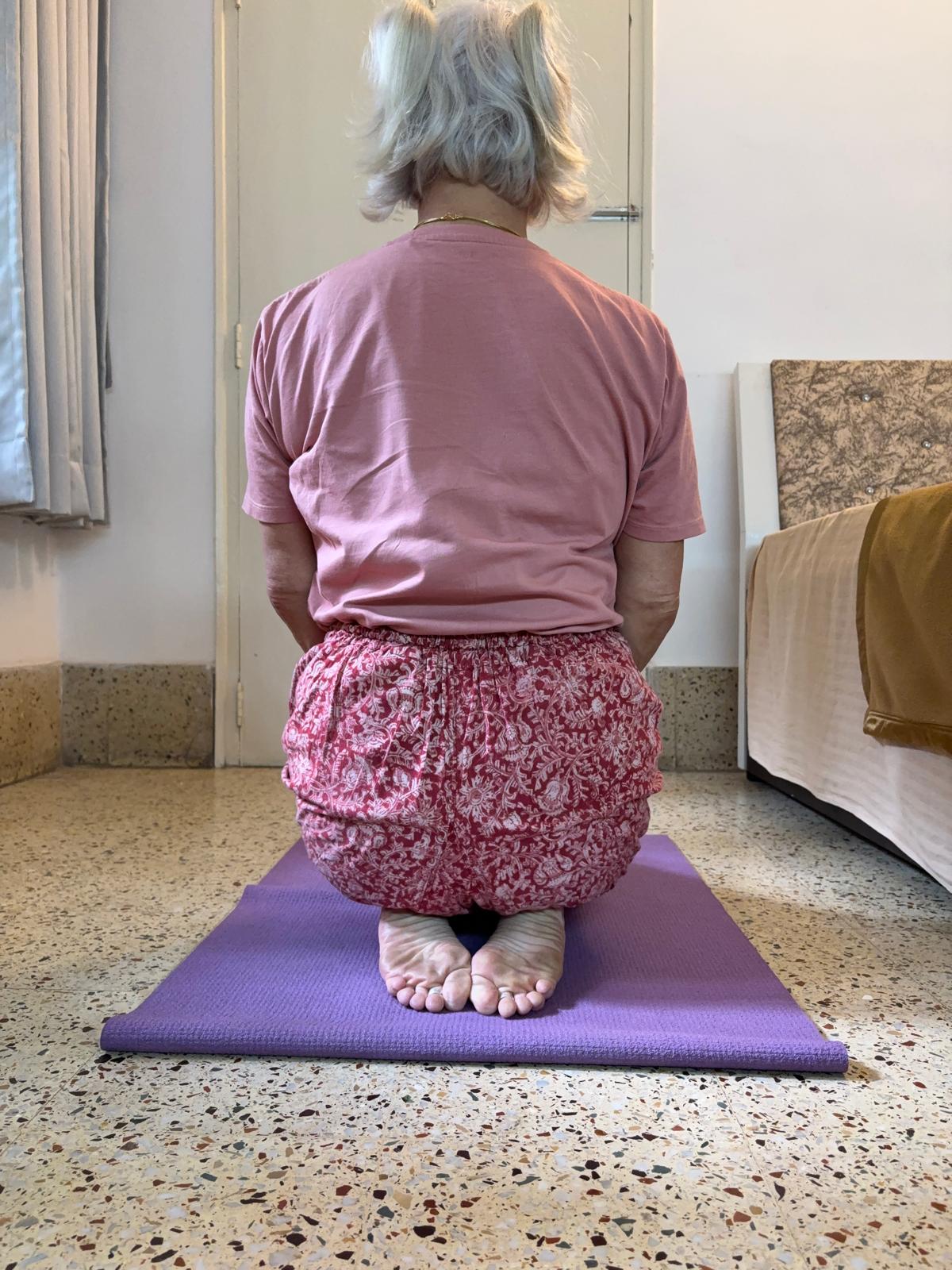
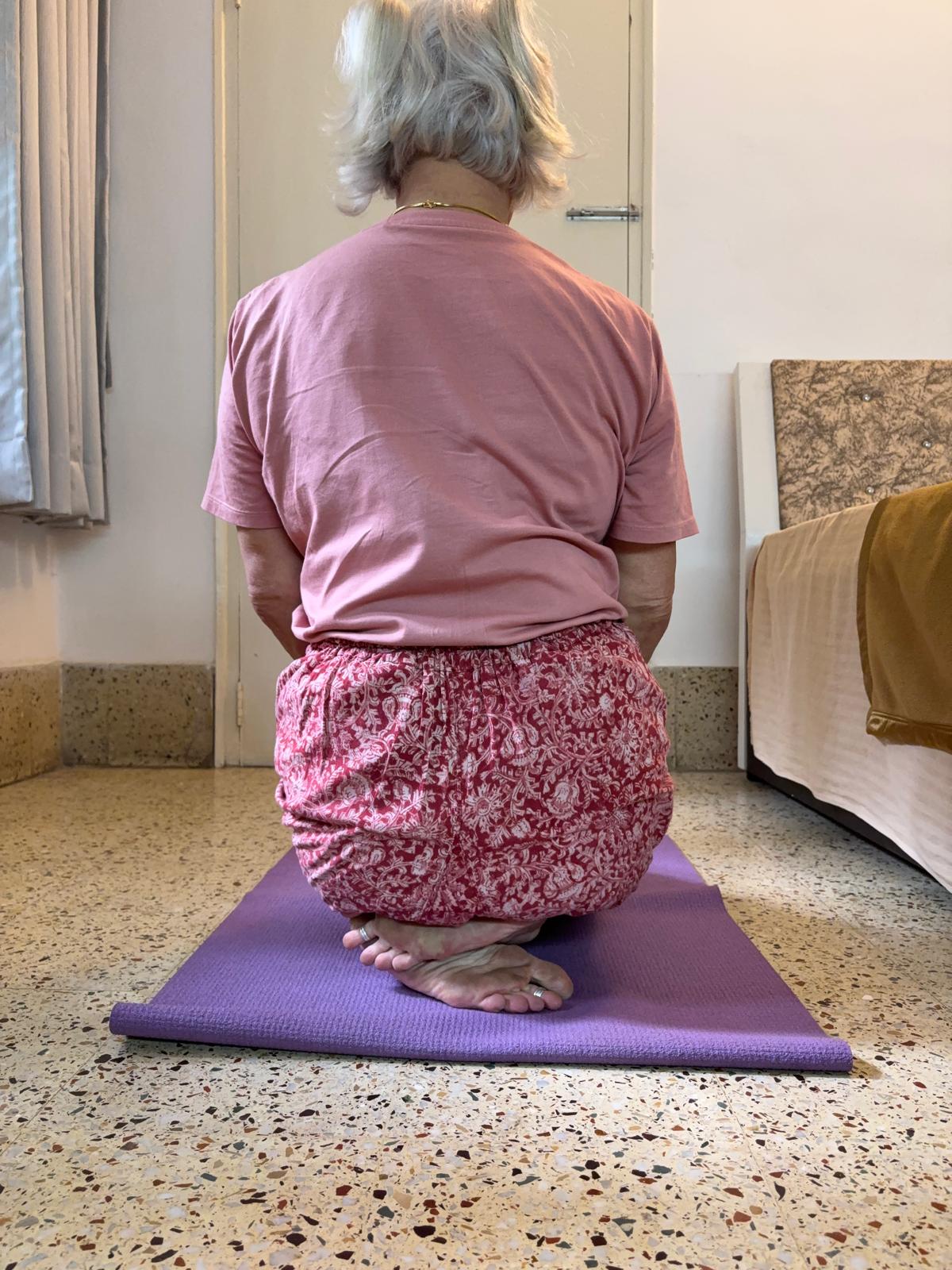
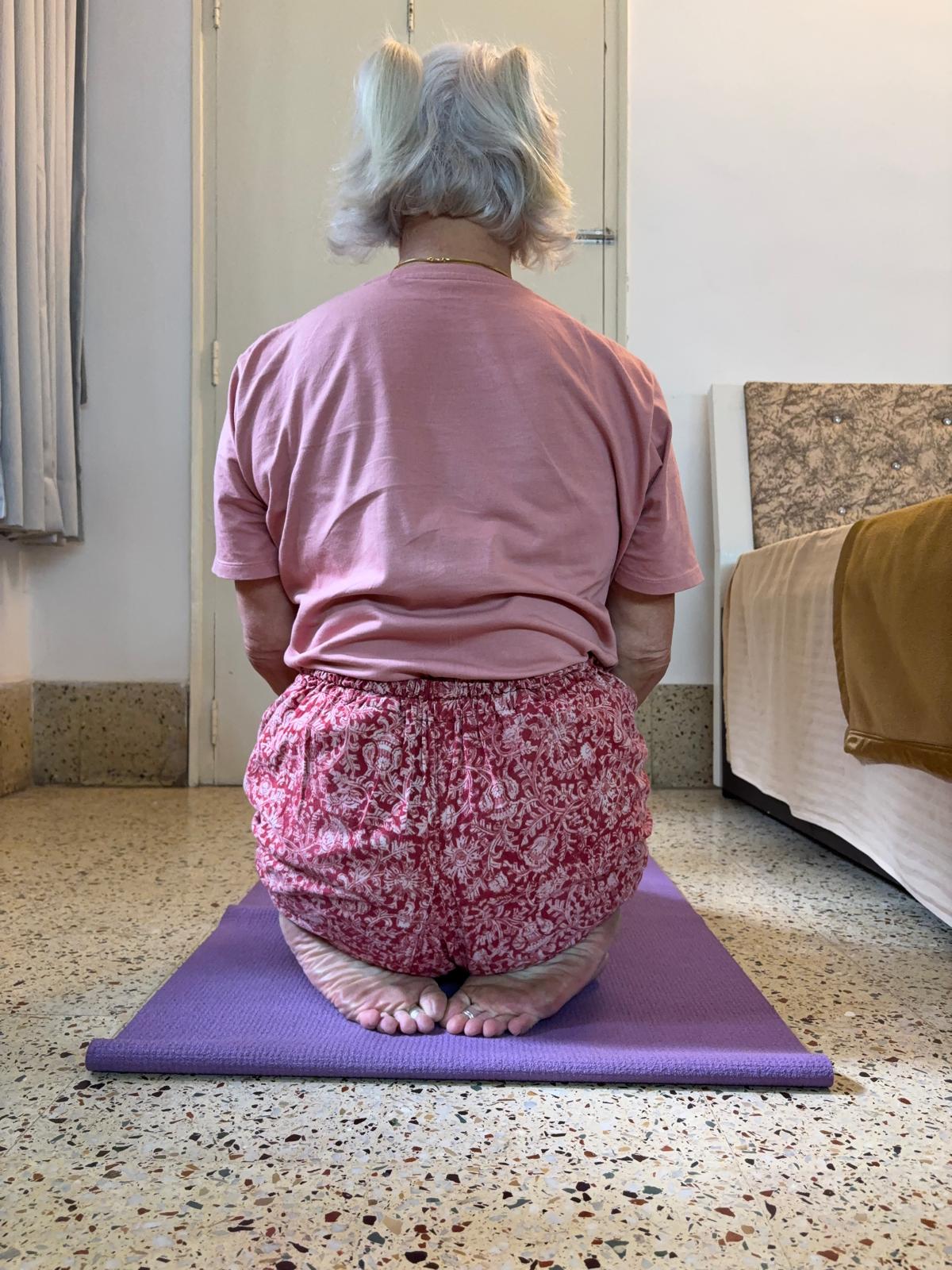
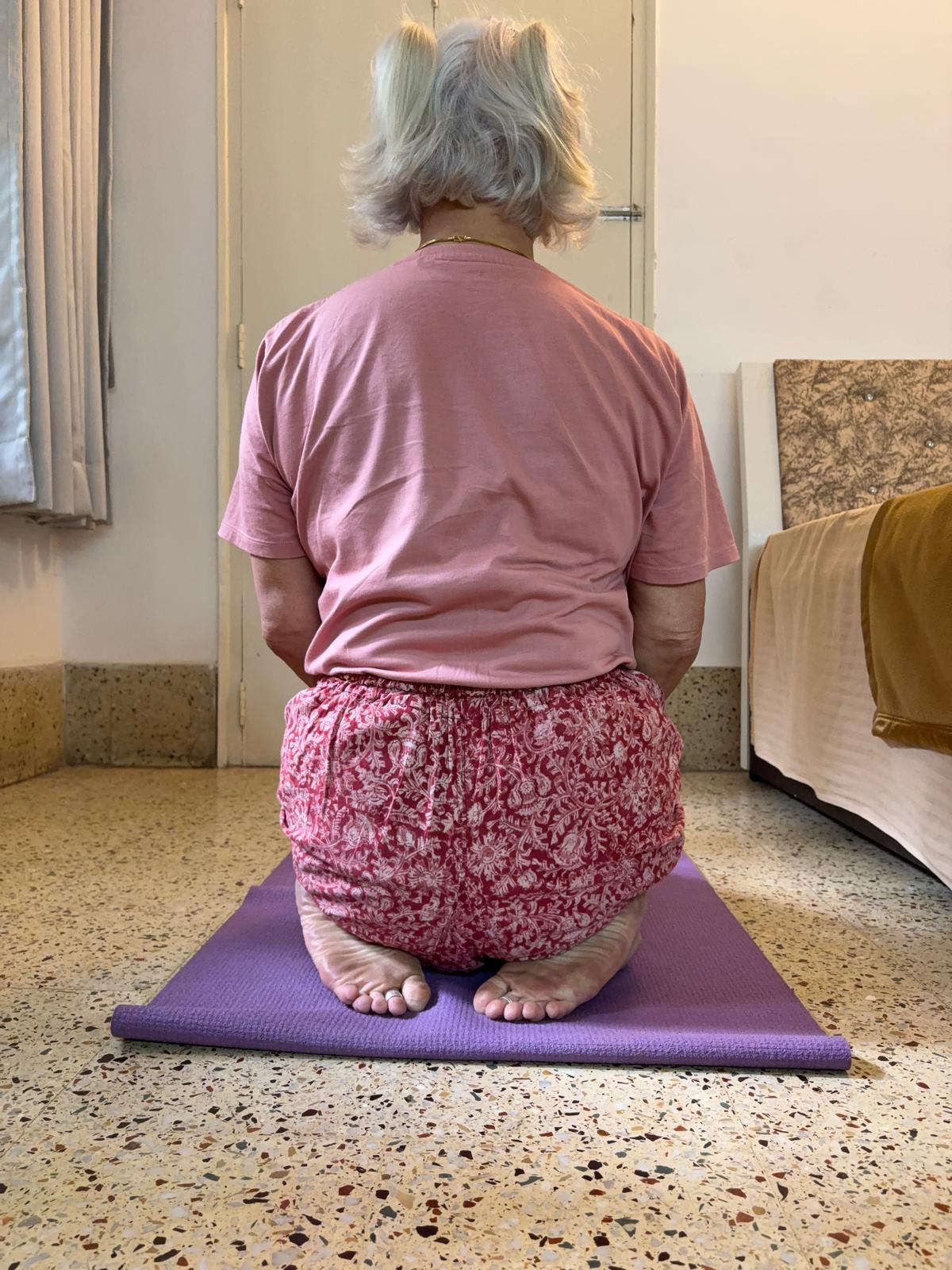
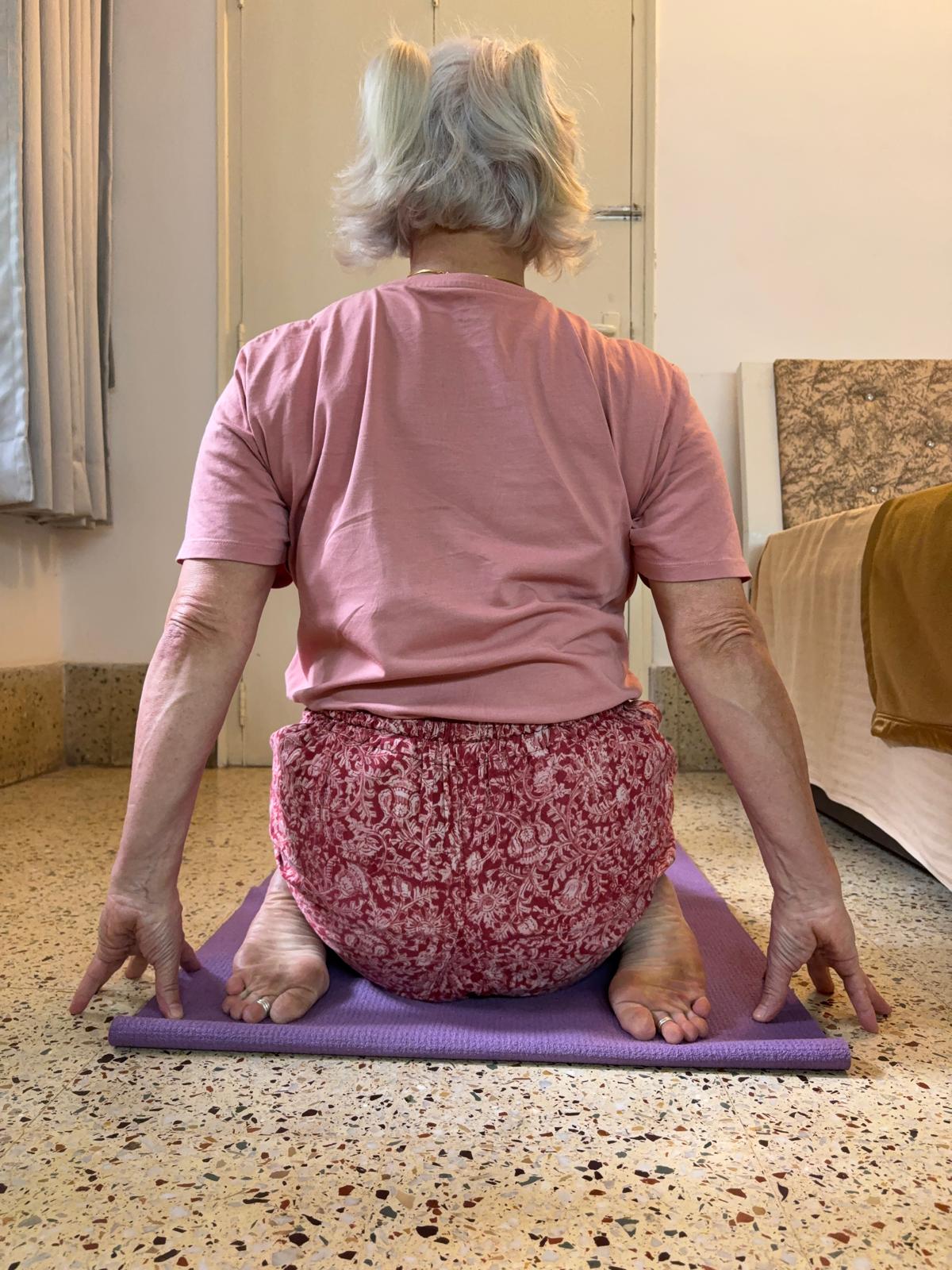
Personal practice time allows one to take care of oneself by attending to fatigue or special conditions, to solidify something taught in class, or to experiment with advanced asanas not taught in class. Nearly everyone has some condition or injury, especially those of us over 50. I have a condition of the foot called “metatarsalgia,” a burning sensation in the root of the second toe when I put weight on it. Abhi suggested that I try all the variations of Virasana shown in Light on Yoga. This work has greatly reduced the pain in my foot so I don’t have to limp. I’m sharing it with you in the Suggested Practice section below.
Abhijata and Raya keep watch in the hall while also doing their own practice. They are there for consultation if needed, and to make sure that no one is misusing the props or doing something potentially injurious. They are keeping a close eye on me every day as I am here for a three month advanced assessment.
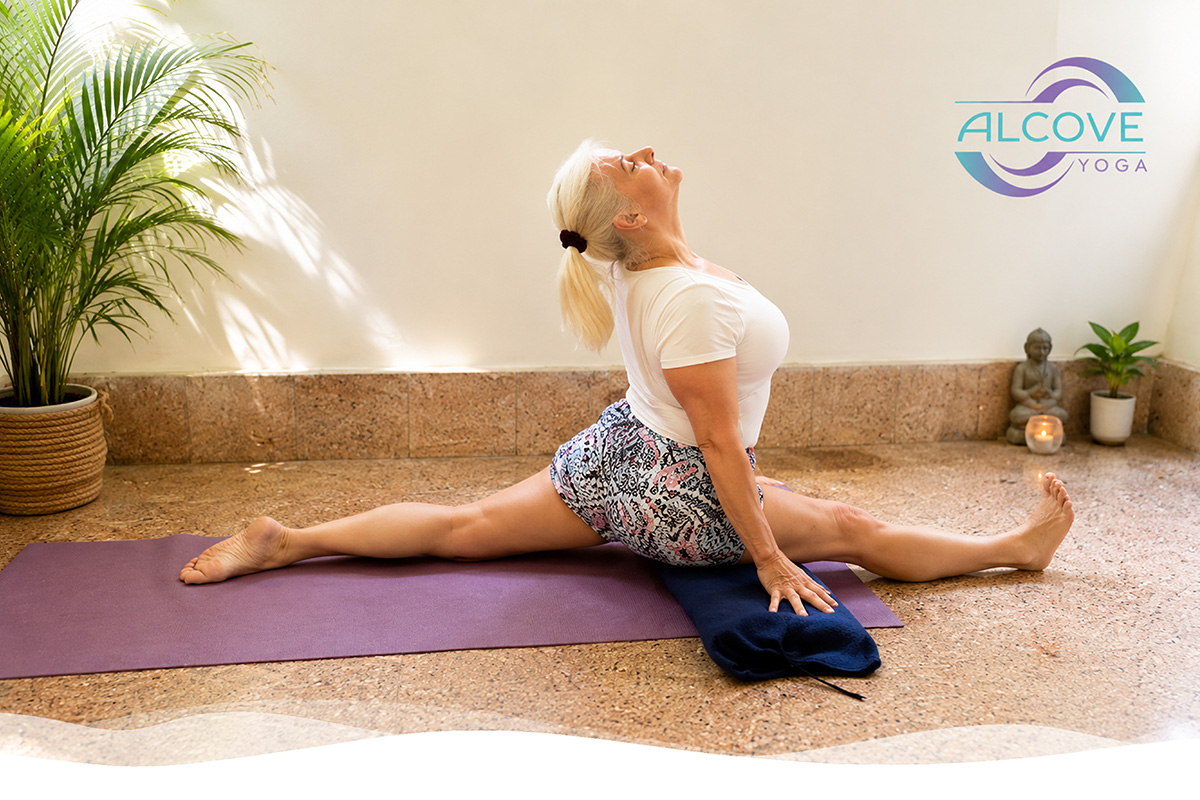
Last week Abhijata approached me in the practice hall. She said she had not yet seen me doing supported backbends with long holds of say 6, 8, or 10 minutes, and wanted me to do this type of practice. So she and a couple of senior teachers helped me learn how to do Dwi Pada Viparita Dandasana, Eka Pada Viparita Dandasana, Urdhva Dhanurasana, and Kapotasana with different props. These included the rope wall, a large barrel called the “drum”, the trestle, a column, a chair, and a tall stool with cross pillows on top near the grill. I don’t have all these props so the whole practice was a new experience for me. I learned that you have to find ways to make intense asanas breathable, and learn to decrease muscular effort in order to stay in the pose. The effects that I gathered were twofold; the nervous system and mind get profoundly quietened; the digestion gets sorted out.
Beyond the unparalleled variety of props at RIMYI, the practice hall is a place of community. For the locals it must be a regular sense of chaos and uproar each month; they have to accept a new group of foreign visiting students who have no idea what the ground rules are or how to arrange the props back in storage. This is the first time I have stayed beyond one month and I even got this feeling at the beginning of July and August. But then there is the thrill of seeing old friends from around the world that you know only from your common experience at RIMYI, and then too, seeing Americans from states outside of Texas.
This is my fourth stay in Pune and it’s the first time that Institute staff and local students have learned my name. Remembering names and faces is one of my super powers, and I’ve made use of it to befriend Indians and visiting students alike. I’ve gotten accustomed to casual interactions with other practitioners who greet me and ask how I’m doing, or “What’s on the menu today?” or “Can I support you in that?” or “Will you help me?” (place a prop or learn to use a prop; or snap a photo). These face-to-face interactions in the practice hall make for a real community. Small bits of conversation or assistance open the door for greater conversations or lunch dates; or even invitations to someone’s house.
Suggested Practice: Work on Feet and Shoulders in Virasana
In all asanas below use as much padding or support as you need to make the pose bearable. For knee pain, place a blanket behind the knees before sitting. For ankle stiffness place shins on a stack of blankets and allow the toes to drape off the edge. You can even sit on a wide bolster. Where possible I have given the plate numbers in Light on Yoga, LOY.
- Virasana sitting on heels, knees together (not shown in Light on Yoga).
- Virasana with toes pointed inward, one foot stacked on the other. Plate 85.
- Virasana with toes pointed inward, tips of toes of right foot touching left foot. Sit in the saddle between the heels. Plate 86
- Now take the feet wider apart, still turning toes inward. Plate 87
- Virasana “classic” with toes pointing straight back. Sit between the heels. Plate 88.
While sitting in these variations of Virasana, take the arms in these positions: Urdhva Baddhanguliyasana (arms stretched upward with fingers interlocked); Paschima Baddhanguliyasana (fingers interlaced behind the back); Paschima Baddha Hastasana (holding elbows behind the back); Gomukhasana; and Paschima Namaskarasana (prayer hands behind the back).
You may end your practice here or you may feel like doing Adho Mukha Svanasana (Downward Dog) and then start your standing poses. Who knows where it will lead you!