


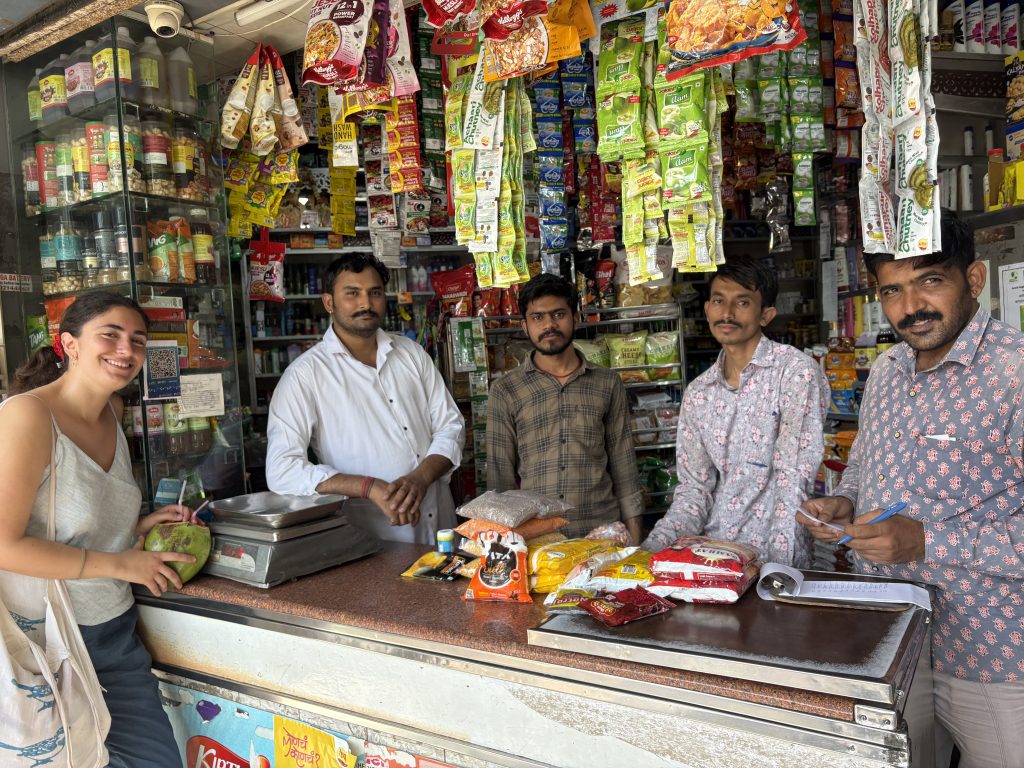
The helpful guys at OM Supermarket, pictured with flatmate Ella.
This week I want to describe what I have come to love about the neighborhood surrounding the Iyengar Institute. You’ll understand the charms of this place and why students keep returning despite our challenges with noise, construction, heat, traffic, and dust.
Everyone is helpful. Any shopkeeper who speaks any English will try to understand your needs and help you out. People in Model Colony, the neighborhood surrounding RIMYI, are well-accustomed to foreign students coming every month speaking English with various accents. The visiting students of RIMYI provide vital support to local businesses. Drug stores (chemists), fruit and vegetable vendors, chai stands, restaurants, and tailors slow down considerably during the month of May when the Institute is closed. Landlords have empty apartments.
The stall-men and shopkeepers know that we are vital to their business, and perhaps for that reason they happily do what they can to accommodate us. But it may also be that they are just kind and helpful. For example, when buying the weekly groceries at the Om Super Market, the seller went to a neighboring store to get the yogurt that I couldn’t get at his store. He added it to my pile so I could check out there and not have to make a special trip elsewhere.
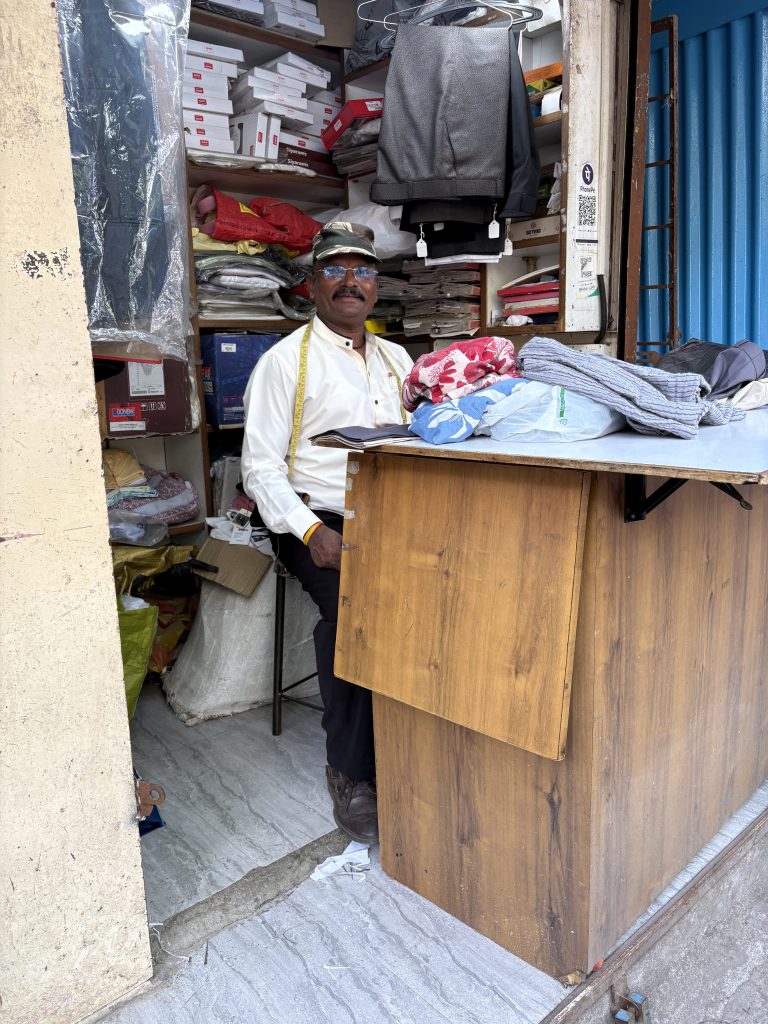
I stopped by the tailor’s stall near the park, Chittaranjan Vatika to have three pieces altered. He agreed though seemed more interested in the possibility of stitching custom clothing for me. “With what fabric?” I asked. He then suggested we go to Laxmi Road on his motorbike and pick out fabrics. When I told him I didn’t have any patterns, he said, “I make the patterns.” It turns out that he has served many RIMYI students and members of the Iyengar family. I saw Prashant Iyengar’s name in customer book, he said proudly: “I was tailor for Big Guruji for 25 years!” The three pieces I had altered cost me a total of 300 Rupees, or about $3.15.
I went to a little religious bookstore in central Pune. It was hot. While discussing the literature I was seeking, the seller offered me chai. Well and good, this happens frequently in any store where you’re spending some time. But then, later, as I was waiting for an Uber (8 minutes turned into 20) I said I had to leave to get a bottle of water. The man stopped me and pulled up his own bottle of water from below. After satisfying myself that it was filtered water, I accepted and pulled out my steel water bottle. He filled it, even though I kept telling him “Bas” (enough!) as I didn’t want to deplete his source.
There is a Chai and breakfast stand near the Institute that Raya has been patronizing for over 20 years. He brings the visiting students there after class. The same man is there every single day. In addition to spiced tea, he makes Upma, Samosas, Pohe, and a spicy tomato-based soup called misal.
It is customary to pay after you are completely done eating and drinking, in case you want a second round of anything. On this day the bill was 60 Rupees, and I had nothing less than a 500 Rupee note. So the vendor said, “pay next time” and made a rolling hand gesture indicating the future. The next day I went there to get chai and upma, which is roasted semolina mixed with fried onions, herbs, spices, and chilis. When I was done, I left, forgetting to pay. The next day I just reminded the man what I had had the previous two days and paid for it then and there, with no further discussion.
I bought 3 bananas and 2 apples from a fruit vendor on the corner near my house. Again I didn’t have the exact change but this time he owed me 10 INR. He suggested he would pay me “tomorrow” if I came by. Ten Rupees is about 11 cents and not in itself worthy of a trip to the fruit vendor.
Amin, a rickshaw driver for visiting RIMYI students, does not even run the meter when he drives you. If he knows you, he just takes what you offer him at the end of the ride. He calls out to me after practice, and I walk back to him, shaking hands. He takes me on a 5-minute ride to my apartment. He knows it is hot, that I am tired after practice, and I’ll gladly take a ride home. I hop in. He also knows the struggle I’ve had with my apartment (don’t want to be dramatic but there is construction on an apartment complex right outside my bedroom window and the noise from power tools is intense.) He tells me, after 5 days at the Institute, that my face is getting brighter every day. He mentioned that he could feel that I was not happy on the previous days and he is happy to see me glowing now.
I know from other drivers and the Uber app that the ride home usually goes for under 50 INR. I don’t have anything less than 200, so that’s what I give him. The next day, I pay him 100. I and others pay Amin more than the going rate because he knows us and provides a customized service, taking us all over town to get what we are looking for, waiting at each stop while we do our shopping.
These interactions and exchanges with vendors make me feel connected and known in the neighborhood. The locals know that the white people walking around Model Colony are studying at the Iyengar Institute. The merchants bend over backward to help us in small ways: by making a phone call, giving directions, watching over our shopping bags while we go to a nearby shop, offering chai.
Allowing people to pay later is a sign that they trust you are coming back. Requesting to pay later is a way of reaching out and saying I’m sure I’ll see you again. Trust me. I’m good for it.
I hold these experiences in contrast to what I do back home: sit in my living room and shop online. When we buy online, we miss these basic, trust-building human connections. The ease of identifying a want or need and then ordering it with a few clicks offers immediate satisfaction, but we lose the face-to-face encounters with casual acquaintances. Over time, this pattern can lead to isolation and loneliness. We cannot replicate this exactly in Houston, because we do not have street vendors offering fresh food, drink, or services like tailoring or shoe repair at a fraction of the cost of a brick-and-mortar establishment. Still, there is a lesson here about the importance of casual, face-to-face interactions in building community. I hope that Alcove Yoga, as a small place where people regularly gather for something uplifting, offers that same feeling of community.
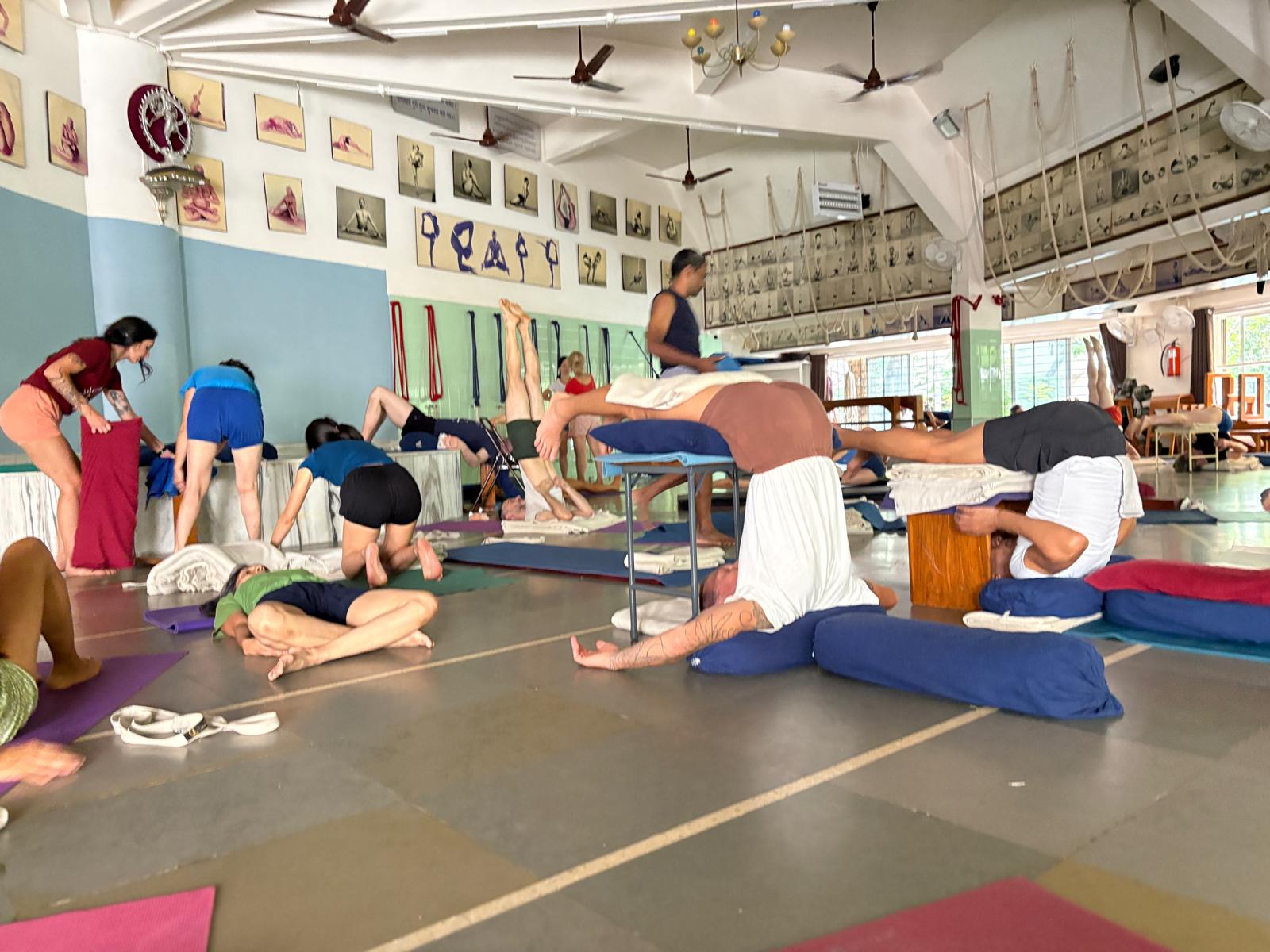
P.S. You may be wanting pictures of people in asana. I can’t give you that because photography is prohibited in the yoga hall.