



Pauline Schloesser, Ph.D., Certified Iyengar Yoga Teacher, IAYT Yoga Therapist
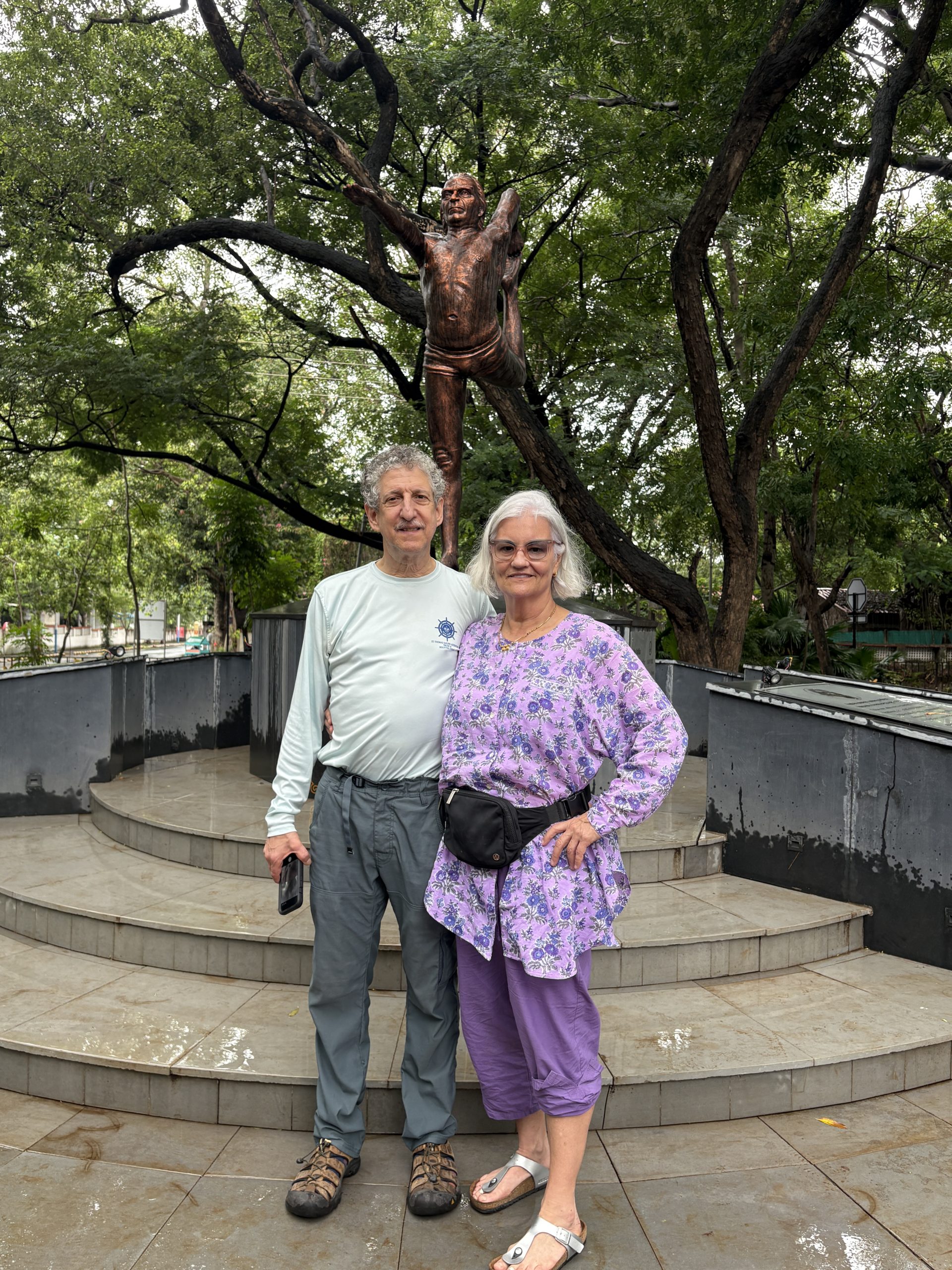
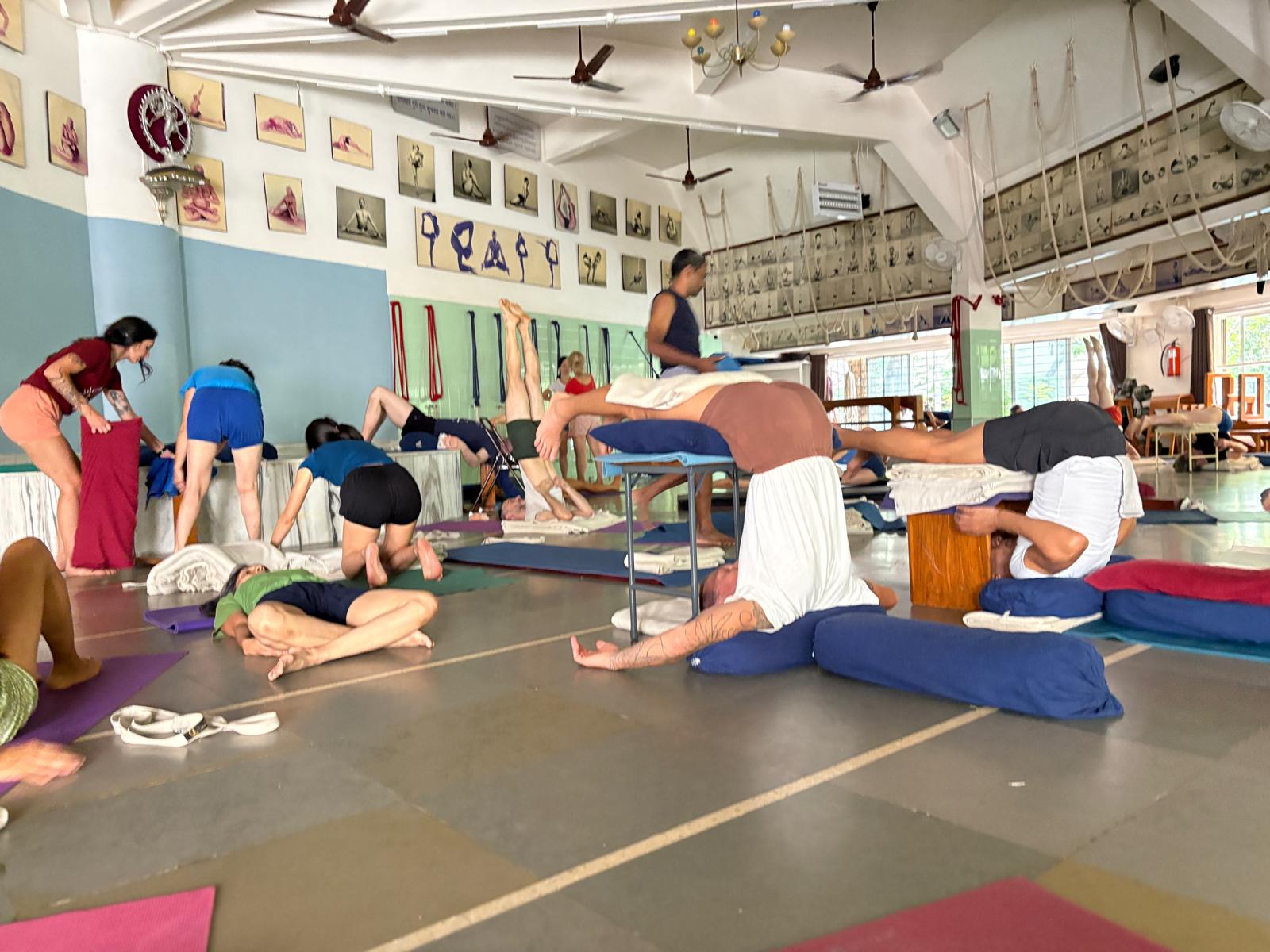
Coming to Pune in June means enduring temps in the mid 90s with 85% humidity and no AC. The climate is very much like Houston’s in the summer. In the yoga hall at the Iyengar Institute (RIMYI) we open the windows and run the wall and ceiling fans. We can’t do this in Houston because the humidity would ruin the wood floors in ourhouses and make the paint peel. But the floor in Institute is made of stone. The platform is marble.
The fresh air feels surprisingly great on the body. Because of the humidity joints are loose, skin and muscles soft. You just have to be careful to do a practice appropriate for the conditions. If you do a lot of arm balances and backends, you will sweat profusely and possibly get overheated. Visiting students also walk a lot to get essential supplies in neighborhood stalls and stores. I’m staying 1km from RIMYI and walking there and back twice or more each day. This much activity requires constant hydration, and multiple showers per day.
The first week of the month focuses on standing Asanas. Here’s a sequence for your home practice. Try to hold each asana 45 – 60 seconds, or at least several cycles of breath.
Practice Sequence 1*
- Adho Mukha Vīrāsana
- Adho Mukha Svānāsana
- Uttānāsana (repeat 2 and 3 once or twice).
- Tāḍāsana
- Tāḍāsana with arms in Ūrdhva Hastāsana. Go for length in sides of the trunk.
- Pārśvottānāsana: take R leg forward, L leg back. Raise arms to Ūrdhva Namaskārāsana. Keep trunk and raised arms in line, extend forward, until trunk and arms are parallel to the floor. Hold for a few seconds, then place hands on ground or support. Move arms as far forward as possible to elongate the trunk. If the trunk is rounding take higher support.
- Adho Mukha Śvānāsana. From Pārśvottānāsana, just step front leg back.
- Pārśvottānāsana, left leg forward.
- Adho Mukha Śvānāsana
- Uttānāsana
- Tāḍāsana
- Bharadvājāsana – on floor or sitting in chair (chair twist).
- Adho Mukha Śvānāsana
- Parivṛtta Trikoṇāsana. From Downward dog, step the R leg forward. Place left hand on the inside of the right foot and right hand on the waist. Press the back heel down and turn the trunk to the right. When the shoulders become perpendicular to the legs, raise the top arm straight up toward the ceiling. Your face should face the right. Undo and come to
- Adho Mukha Śvānāsana
- Parivṛtta Trikoṇāsana, left leg forward with R hand in the inside of left foot. Then step back to
- Adho Mukha Śvānāsana
- Prasārita Pādottānāsana. Aim to get the head to come down to the floor. If you are having trouble, try this: Take the hands forward on the floor as in Downward facing dog. Gradually bend the elbows and let the head come down closer to the floor. Gradually work to get the arms more in line with the feet keeping the head down.
- Śīrṣāsana (head balance). If you don’t do Śīrṣāsana for any reason, do Supta Pādāṅguṣṭhāsana I and II. (this is the Supine Big Toe pose, in which we often use a strap to hold the foot and take it 90 degrees up, or to the side.)
- Bharadvājāsana on floor (or chair twist) again, focusing on preparing the chest and shoulders for Sarvāṅgāsana (Shoulder Balance). Get the arms to roll inside out, broaden the chest, revolve the trunk, and tuck the shoulder blades into the back.
- Sālamba Sarvāṅgāsana (Shoulder balance) or Setu Bandha (Bridge formation pose).
- Savasana
Suggested Aide for practice: Interval Timer App.
I suggest that you first review the sequence to refresh your memory on the names of the Asanas. Once you recall the asanas you are ready to start your practice.
I have found that an interval timer can be a wonderful tool to make sure I am holding each side of an asana an equal amount of time and resting between the asanas. Here is an App you may find an interval timer quite useful. And here is one for Android